
The Framework Finder
Stop guessing which framework fits: start from the question on your mind (“why did this really happen?”, “which project goes first?”) and the Finder gives you the framework and the page to turn to.
For people who are great at execution

You know the work. What the room hears is the order you say it in. Frameworks on One Page gives you 50 business frameworks in the Question-First format: start from the question you were asked, run the framework in about 20 minutes, and walk in knowing your first sentence.
Every framework, the same 7 parts:
7-day money-back guarantee. If it doesn't help, email us and we refund you in full. No forms.
Secure checkout by Stripe · Files by email in minutes
Why it comes out as an opinion

At your last performance review, they put it kindly: you've nailed the tactical side, now be more strategic. Nobody told you what that means. Here is what it looks like in the room.
The VP asks a question. You did the work, you know the numbers, so you tell it the way you lived it: first we looked at this, then we found that, maybe it is pricing, maybe onboarding. Then someone else walks to the whiteboard, draws four boxes and says: “Two causes. Here is what I would do.” The room follows them. Half an hour later, back at your desk, you have the better answer in one line. Too late.
That is the timeline answer. It is not a talent problem and it is not a knowledge problem: it is translation. You think in the order you did the work; senior people listen in the order they decide, the answer first and then the why.
More frameworks do not fix it. The 300-page classic gets put down at chapter one. The one-page summary tells you what a SWOT is, not how to run one on your problem tonight. The library of a hundred models never tells you which one fits the question in front of you. What changes the room is starting from the question, and that is how this book is built: each framework on two pages, ready the night before.
The Question-First format
Most business books teach frameworks by name. Nobody in a meeting asks you for a name: they ask a question. So every spread starts where you are, with the question on the table, and ends where you need to be, with the line you say in the room. Seven parts, always in the same order. Here they are on the real SWOT spread.


Why this order? It is the order a senior answers in: the question, the structure, the reasons, the conclusion in one sentence. The sentence comes last because the steps and the example earn it. A line with no thinking behind it sounds worse than silence; with the thinking behind it, it sounds like you.
Look inside
No mockups and no blurred pages: these are the spreads exactly as you get them. Swipe through them, and tap one to open it full size.
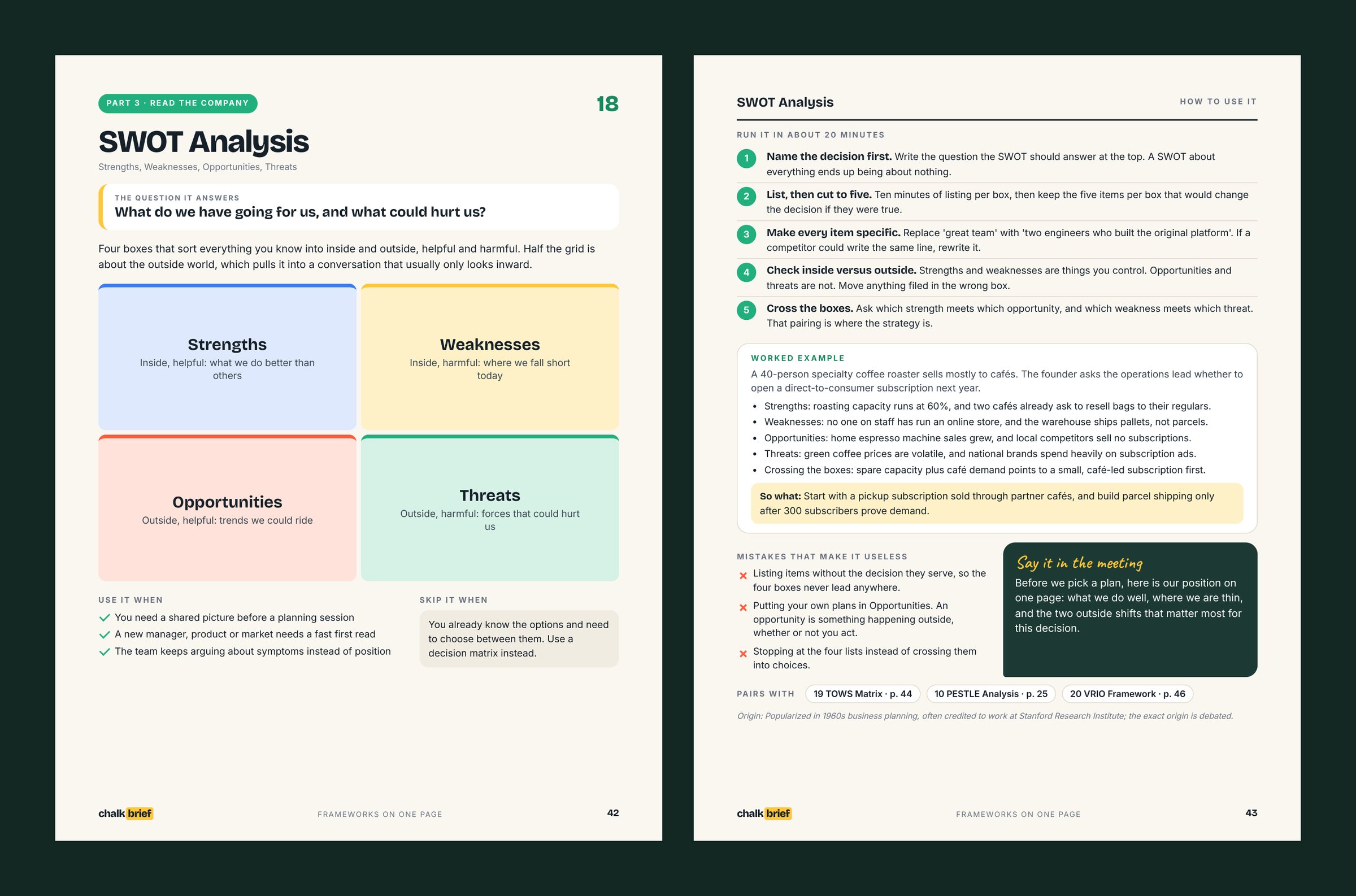
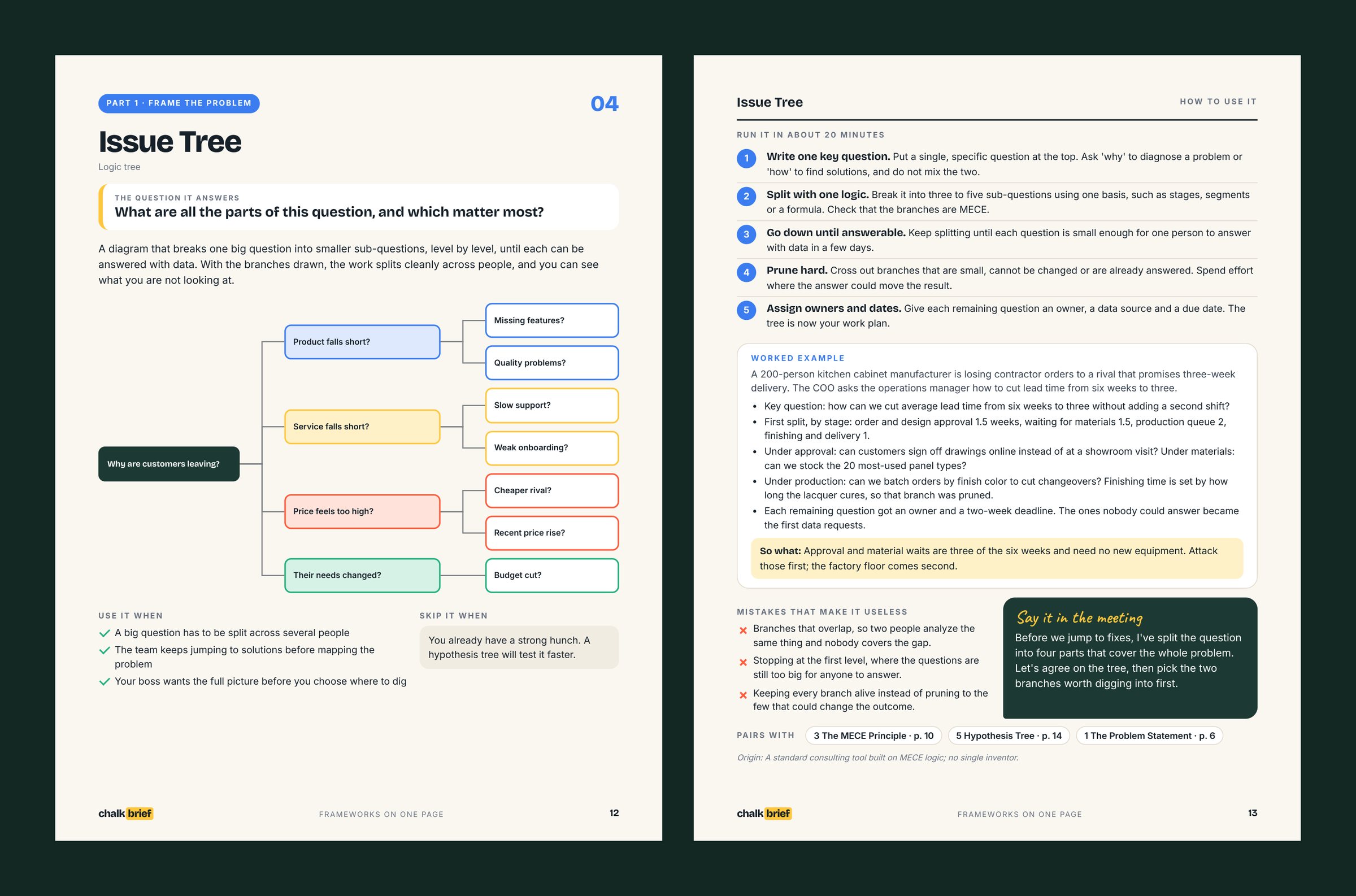
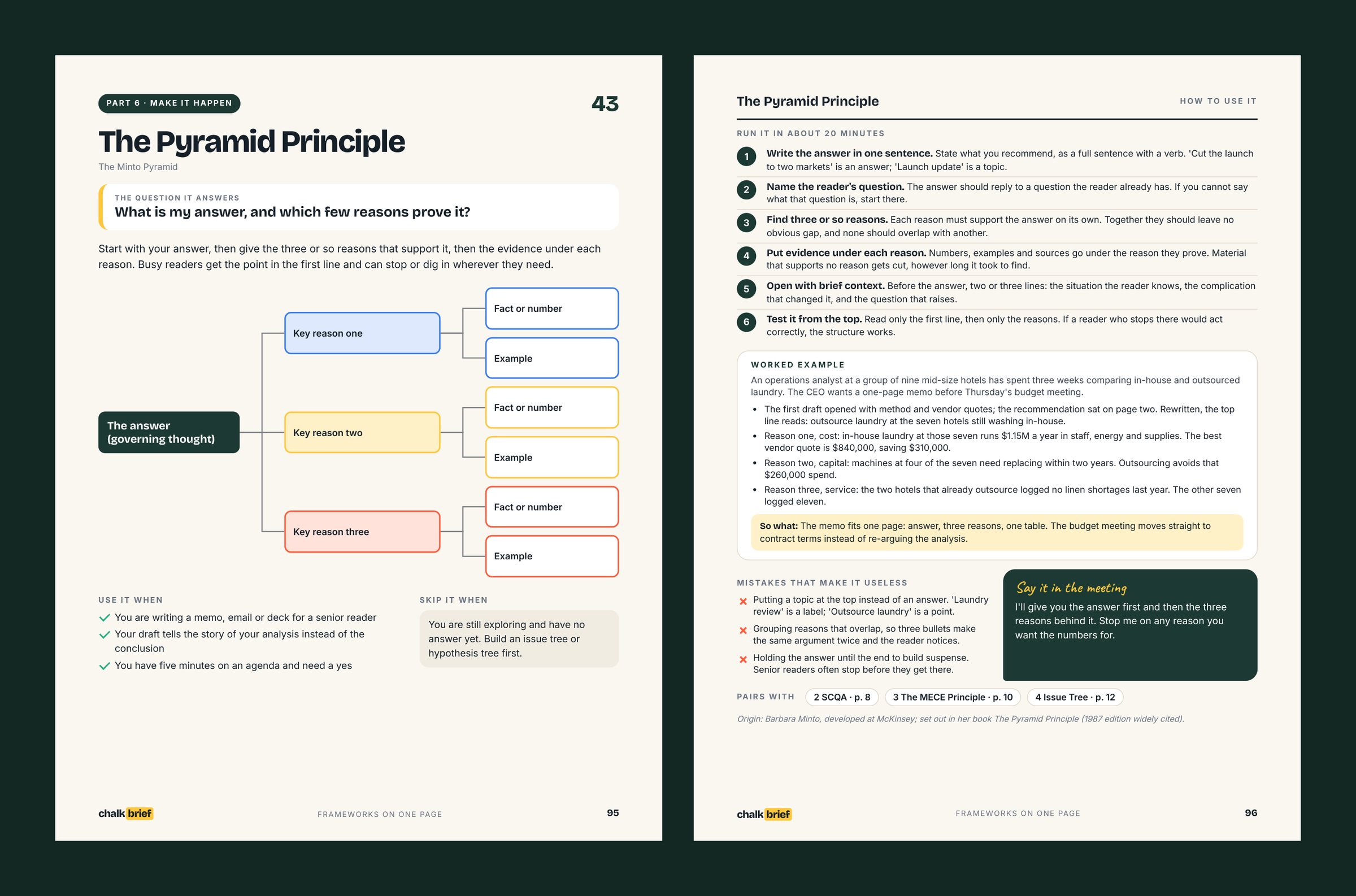
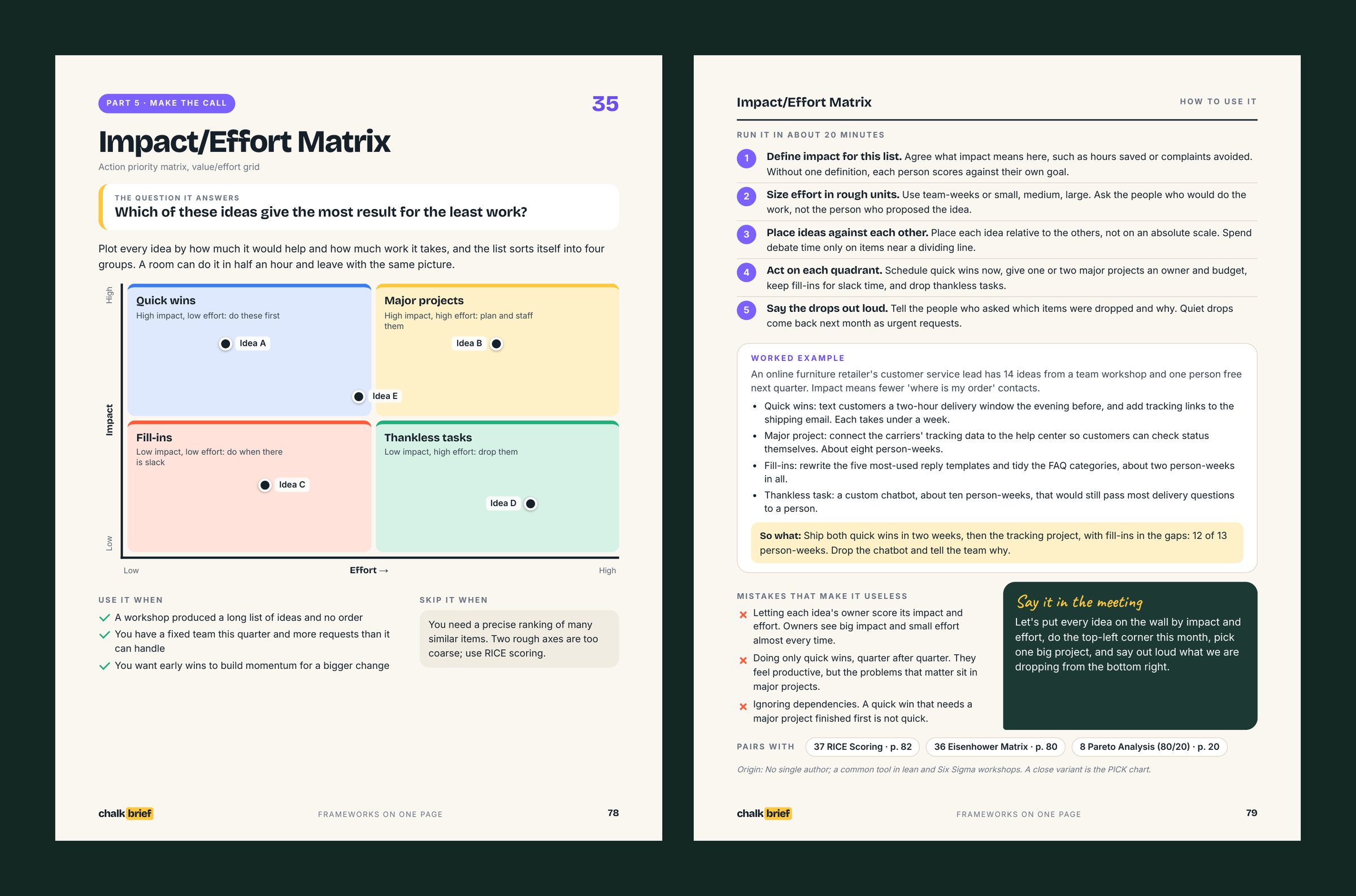
Swipe for more · tap a spread to open it full size
What's inside

You rarely know which framework you need. You know what you are being asked. So the book is built on six questions: what is really going on, what is happening out there, what do we have to work with, where do we grow, which option, how do we get it done. Find yours, and the right frameworks are under it.

Every framework ends with Say it in the meeting: the line that opens the discussion, in plain spoken English. The hardest part of a meeting is the first ten seconds of your turn. Now you know exactly how to start, and why it is the right start.

No 300 pages of anecdotes for one idea. Every spread follows the same seven parts, so after the first one you know where everything is. Open it when you are stuck, the night before a meeting, or ten minutes before you present.
What is really going on? The Problem Statement, SCQA, the MECE Principle, Issue Tree, Hypothesis Tree, the 5 Whys, Fishbone Diagram, Pareto Analysis (80/20), KPI Driver Tree.
What is happening out there? PESTLE, Porter's Five Forces, TAM SAM SOM, Needs-Based Segmentation, Jobs To Be Done, Perceptual Map, Competitor Comparison Grid, Customer Journey Map.
What do we have to work with? SWOT, the TOWS Matrix, VRIO, Value Chain, McKinsey 7-S, Business Model Canvas, Process Map and Bottleneck.
Where do we play, and how do we win? Ansoff Matrix, BCG Growth-Share Matrix, GE-McKinsey Nine-Box, Porter's Generic Strategies, Three Horizons, ERRC Grid, Strategy Choice Cascade, Build Buy or Partner, Scenario Planning.
Which option, and how sure are we? Weighted Decision Matrix, Impact/Effort Matrix, Eisenhower Matrix, RICE Scoring, Cost-Benefit Analysis, Pre-Mortem, Risk Matrix, Reversible vs Irreversible Decisions, Second-Order Thinking.
How do we get it done and get people on board? The Pyramid Principle, OKRs, Balanced Scorecard, RACI Matrix, Stakeholder Map, Kotter's 8 Steps, ADKAR, the PDCA Cycle.
Included with the book
Stop guessing which framework fits: start from the question on your mind (“why did this really happen?”, “which project goes first?”) and the Finder gives you the framework and the page to turn to.

Walk in with a finished page instead of a blank one: all 50 frameworks as blank templates, one page each, to print or fill in on a tablet the night before the meeting.

Run any framework on your own numbers with ChatGPT, Claude or Gemini, and know when the answer is wrong: one tested prompt per framework, plus the checklist to judge what comes back. The book picks the tool; the prompt makes the AI use it properly.
How it works
Secure checkout by Stripe. Your download page opens right away, and the files are in your inbox a minute later: the book, its phone edition and the three bonuses.
Open the Framework Finder, start from the question you expect in the meeting, and go straight to the two pages that answer it.
Run the steps on your own case the night before, on the template or with the AI prompt. Open with the line under Say it in the meeting.

Everything you get today
Total value$164
Today$37
On your laptop in minutes and yours to keep, with the phone edition for the commute: open it the night before any meeting, this quarter and every quarter after. Print the pages and the templates you need, as often as you like, for your own work.
7-day money-back guarantee. If it doesn't help, email us and we refund you in full. No forms.
Secure checkout by Stripe. Instant download. Refund policy.
Email [email protected] within 7 days of purchase and we refund you in full. No forms, no questions about why.
Questions
The definitions, yes. What is hard to find is the rest of the page: which framework fits the question you were asked, when to skip it, the steps in order, an example where the numbers add up, the mistakes that make it useless and the sentence to open with. And an AI is only as good as what you ask it: the book tells you which framework to ask for, and Run It With AI gives you a tested prompt for each one, with a checklist to catch a wrong answer.
One-page summaries tell you what a framework is. This tells you how to run it: when to use it and when not to, the steps for tonight, a worked example that ends in a clear “so what”, and the mistakes that make it useless. Scroll up to Look inside and judge four full spreads for yourself.
Most people know the name and use it as a list. Each spread shows when to use it and when to skip it, how to run it in about 20 minutes, the mistakes that make it useless (for SWOT: never crossing the boxes into choices) and the sentence to open with. And SWOT is one of 50.
Used to decide for you, they would be. That is not what they are for. A framework shows the room how you got to your answer, so people can follow it and push back on the right part. Picking the right tool to explain a decision is what clear thinking looks like from the outside.
Lines with no thinking behind them do. That is why Say it in the meeting comes last on every spread, after the steps and the example: it is the conclusion your own analysis reaches. Change the words to yours, keep the order.
Yes. Next to the full book, laid out on US Letter for the laptop, the tablet and paper, you get a phone edition with pages sized for a phone screen, so there is nothing to pinch and zoom.
No, it is a PDF you download and keep. It is laid out on US Letter, so any page prints cleanly for a meeting, and it reads well on a laptop or a tablet. For the phone there is the phone edition, included.
Yes. Your license covers your own work and your own team: print the templates, fill them in, put the diagrams in your slides. What you cannot do is resell the book or share the file publicly.
Then it costs you nothing. Email [email protected] within 7 days of purchase and we refund you in full. No forms, no questions about why. Full policy on the refund page.
No, and nobody can honestly promise a promotion: it depends on your work, your company and the people you work for. What the book gives you is a structure for the problems you already face, and the words to present it. It is educational material, not professional advice.
Write to us and we replace it within 3 business days or refund you. Full policy on the refund page.
One-time offer
This price is only on this page. Tick what you want, then continue to payment. One checkout, one email, everything in it.
7-day money-back guarantee. If it doesn't help, email us and we refund you in full. No forms.
Secure checkout by Stripe. Instant download. Pay once, keep forever.